
There is no shortage of reasons to be frightened about the future.
Scroll through the headlines and you could be forgiven for thinking that humanity is sleepwalking towards disaster. Artificial intelligence will take our jobs. Deepfakes will destroy trust. Climate change will make parts of the planet uninhabitable. Geopolitical tensions could trigger another world war. And some of the most prominent voices in technology have suggested there is a meaningful probability that advanced AI could ultimately wipe out humanity.
So why did we write a book about the future that leaves you feeling hopeful?
Because, having spent months researching the subject and speaking to 30 leaders across business, technology, healthcare, education, sport, energy and other sectors, we came to a rather different conclusion.
Yes, the future is uncertain. It is turbulent. It is sometimes frightening. But it is also full of extraordinary possibility and, crucially, it is still ours to shape.
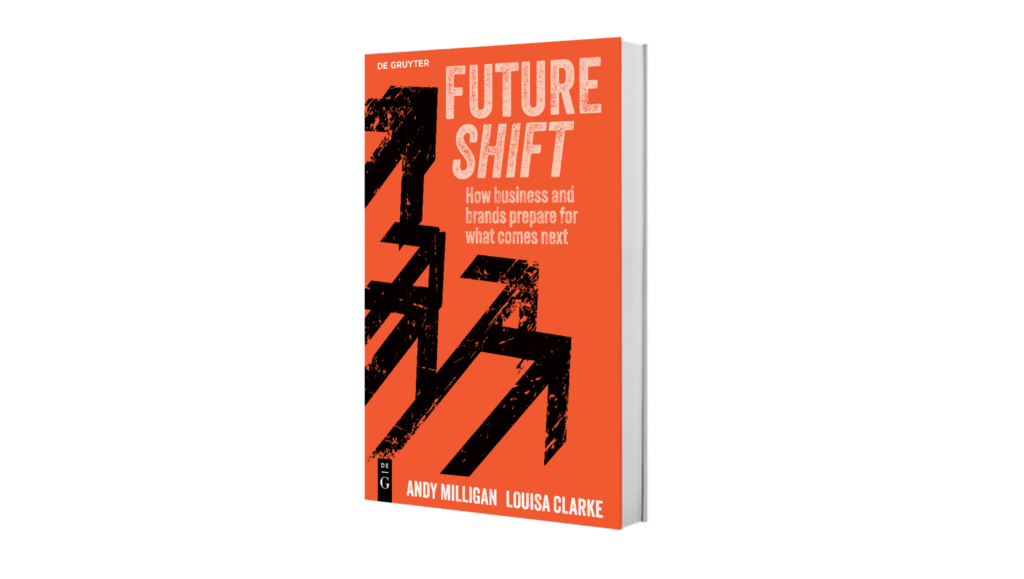
That is the central thesis of FUTURESHIFT How Business and Brands Prepare for What Comes Next. Or to paraphrase Rita Clifton, the Deputy Chair of John Lewis Partnership, we must prepare for the future we want, or we’ll get the one that shows up.
We begin with an uncomfortable admission: nobody knows exactly what the future holds. History is littered with confident predictions that turned out to be spectacularly wrong. The point, therefore, is not to predict the future with precision. It is to understand the forces shaping it, prepare intelligently and develop the capacity to adapt.
Our world is moving from what might once have felt like a relatively steady state into what futurist Jamais Cascio describes as BANI: Brittle, Anxious, Nonlinear and Incomprehensible. That sounds bleak. But our argument is that volatility should not automatically lead to pessimism. If the future cannot be controlled, the answer is not to retreat. It is to become more resilient, curious, adaptable and human.
And this is where AI becomes particularly interesting.
Much of the public debate treats AI as a contest between humans and machines. But our research suggests a more nuanced possibility: AI can become an extraordinary amplifier of human capability.
Our research into Employee Pride with UK employees found that 90% were positive about AI and its impact on their ability to do their jobs. 70% of employees whose organisations were already using AI said it had improved their job. People were particularly enthusiastic about handing repetitive and tedious tasks to technology so they could spend more time on work requiring judgement, creativity, relationships and meaning.
That doesn’t mean there is nothing to worry about.
There are legitimate questions about jobs, inequality, misinformation, deepfakes, concentration of power and what happens if technology develops faster than our ability to govern it. Some of the leaders we interviewed expressed precisely those concerns. One feared that AI could become dangerous if we relied on it without understanding it. Another worried about being outcompeted by AI systems that might not share our conscience. Others feared technology being used to build walls rather than connections.
But these are fears not predictions. And more importantly, they are all hopeful of the future, and their hopes are strikingly human.
They hope for cleaner energy, better healthcare, greater prosperity, stronger communities, peace, opportunity, kindness, tolerance and a fairer society. One leader hopes that responsible use of science, open access and AI can accelerate solutions to humanity’s greatest challenges. Another hopes technology will “build bridges, not walls”. Another hopes for a world in which people and planet thrive rather than merely survive.
That matters because it reveals something missing from much of today’s AI debate.
Technology does not decide what future we get. People do. And the last time we looked, people run business.
One of the strongest conclusions from FUTURESHIFT is that the future will not simply belong to the companies with the most sophisticated technology. It will belong to organisations capable of combining technology with humanity.
The future employee will need to be adaptable, curious, digitally fluent and capable of critical thinking. The future employer will need to lead with empathy, trust and purpose. Customers will continue to demand speed and convenience, but increasingly they will also ask whether the companies they buy from behave responsibly. Brands will become more fluid and participative, but purpose will remain the anchor. Success itself will need to be measured not simply through revenue, but through the impact businesses have on people, planet and society.
This is why the nine big ‘Future Shifts’ we identify in the book are ultimately optimistic. None of these shifts suggests that the future will be easy, but they do mean it will be human. To find out what those shifts are please read the book. Click here to order a copy on our dedicated FUTURESHIFT webpage. You can also read fuller versions of the interviews we conducted, which are not in the book. And you can also give us your own hopes and fears.
As for us as authors, what are our greatest fears and hopes? Well, our greatest fear is not AI. It is what happens when human beings allow greed, the pursuit of power and short-term gratification to determine the future. Our greatest hope is the opposite: that our capacity for long-term thinking, collective responsibility, empathy and enlightened self-interest will enable us to create sustained peace and shared prosperity, with both people and planet thriving.
So perhaps the question we should all be asking is not:
“What are the chances that AI destroys humanity?”
It should be:
“What kind of humanity do we want to build with the extraordinary tools now available to us?”
Because the future isn’t predetermined. It’s ours to shape. That’s why we should be hopeful.
FUTURESHIFT: HOW BUSINESS AND BRANDS PREPARE FOR WHAT’S NEXT is published by De Gruyter Brill. Click here to order your copy